
On Saturday, January 4, I had the profound honor of being on a panel at the closing reception for the Art of Recovery exhibit at Pink Dog Creative.
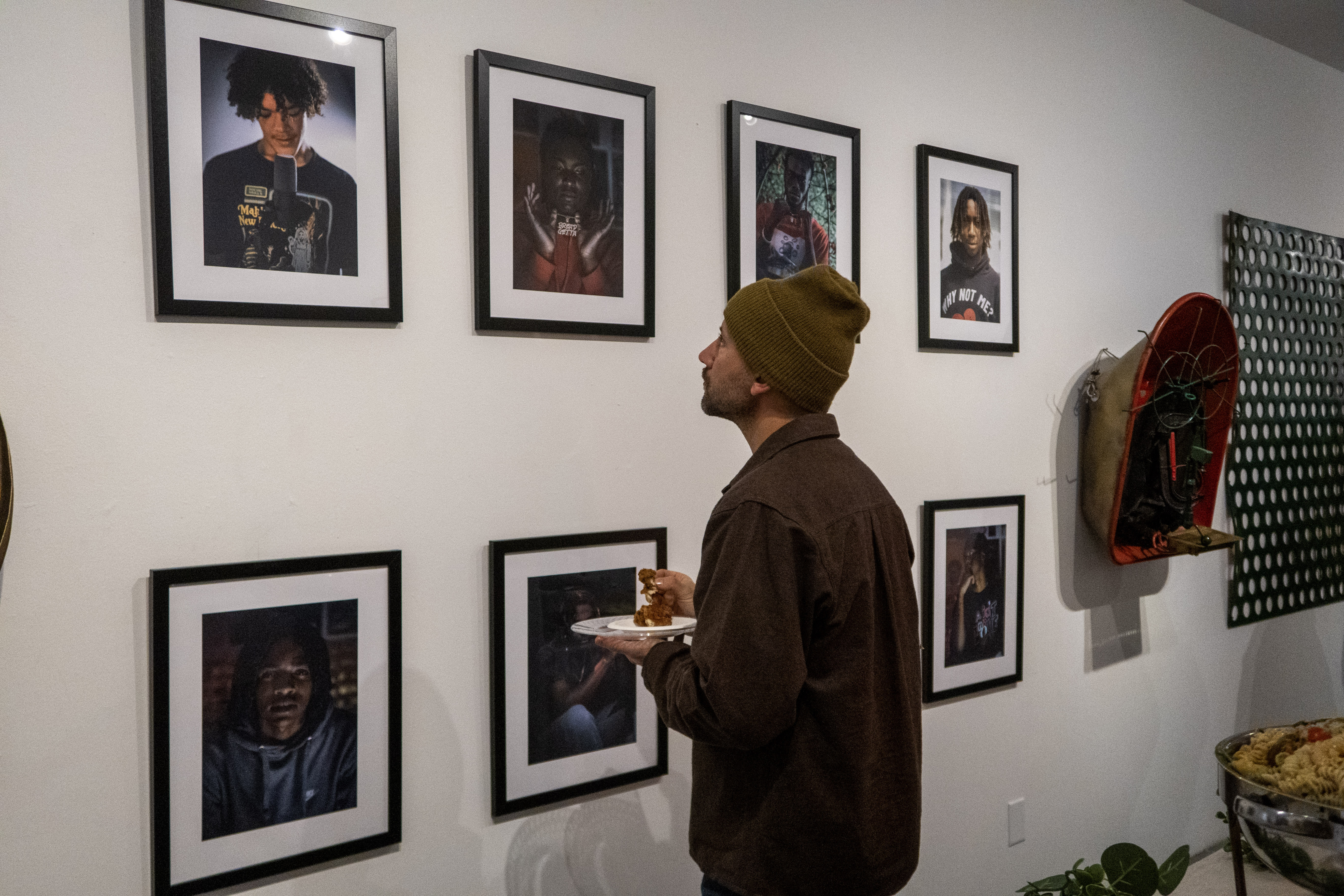
The exhibit, supported by Asheville Creative Arts, brought together youth artists from Hood Huggers International and UMOJA Health, Justice and Wellness Collective, pairing them with adult artists. It included photographs, sculpture using reclaimed materials, fiber arts, video, painting and sound installation.
The show platformed perspectives from Asheville’s Black community, offering a space to meditate on what a just and resilient recovery from Helene could look like.
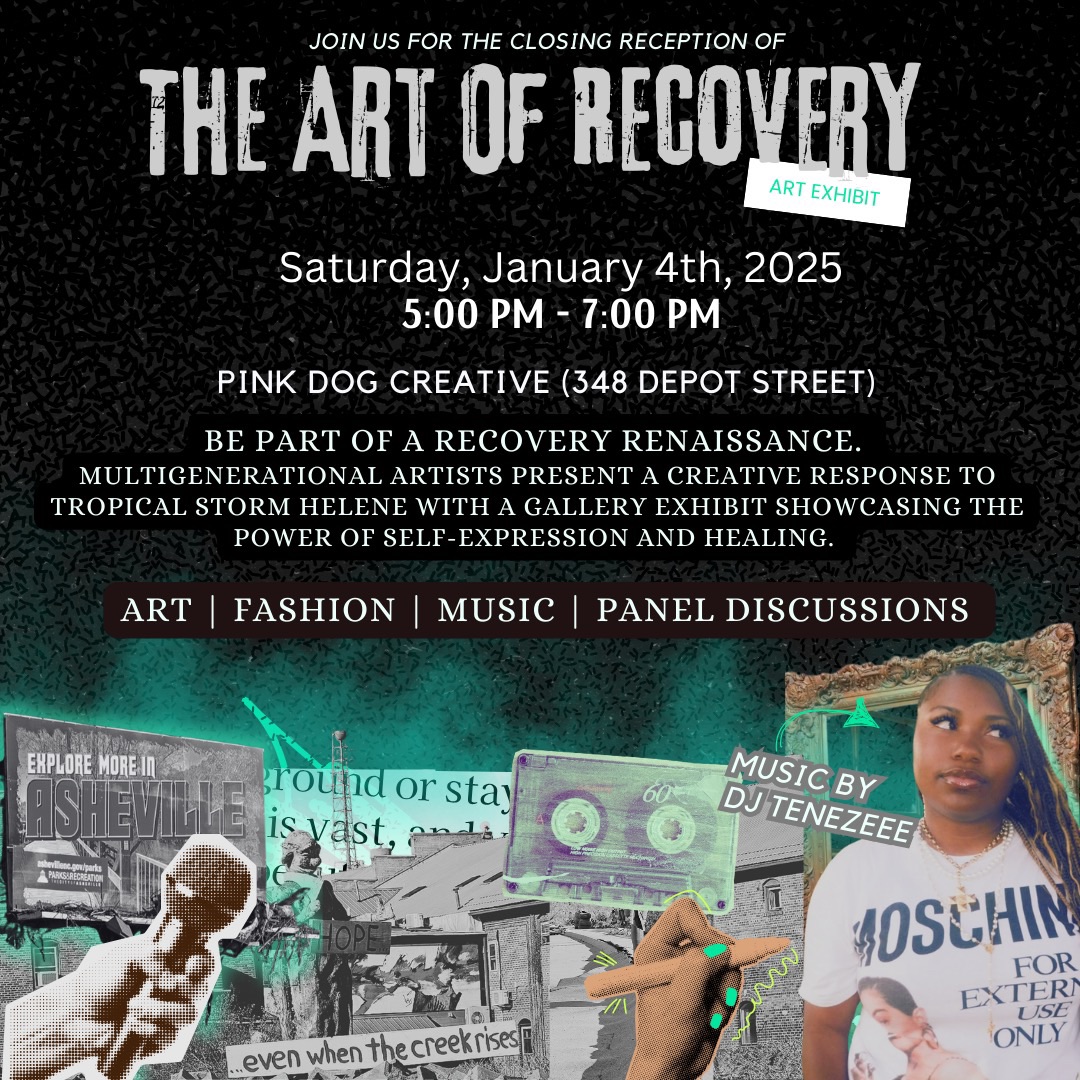
This was also the theme of the closing panel discussion, which was followed by a fashion show, hosted by Slay the Mic, that featured young local designers including Tajaunie Chaplin, Lo Collins (little Brother), and Eunique and music by DJ Tenezee.
It was an inspiring evening that held both the heartbreak of the hurricane and the losses Black communities experienced before the storm and hope for justice as we rebuild.
There were several themes that arose in the conversation, which I’ve attempted to capture below. May we fertilize and grow the visions that were shared, and boldly address the barriers to manifesting them.
Links are included throughout so you can throw down with these badasses!

The Art of Just Recovery
Tamiko Ambrose Murray, a writer, cultural worker, racial equity strategist, and co-founder of Spiral Path Consulting was the moderator. She began: “I’m not going to say too much, but what I do want to ground us in is that we understand that the arts are a vehicle for personal transformation for community transformation. It is our ancestral legacy.”
“It is not a nice thing to do or extra like, “the arts, how fun!” It is The Work. Artists have a crucial role, especially in these moments. Toni Morrison said that it is precisely these moments that artists are most needed. And so we are currently in the context of climate disaster, and some of us are still in crisis mode, right? And in addition to that, policy disaster that we can see coming for us.”
“So what can we do? What is the role that artists can play in illuminating the voices of the people who are most impacted by these structures, who are most vulnerable and who get left behind?”
Her questions for the panel were around Just Recovery, and arts based strategies for resilience and resistance in rebuilding from hurricane Helene and in the face of impending policy disasters.
Recovering Right Relationship
DeWayne “BLove” Barton, founder of Hood Huggers International, stated that “a Just Recovery for me would be to ensure that the communities and places that historically have just been hammered are a part of this new era of rebuilding the city. The people who’ve been catching the hammer the longest should be at the front of the line. And if we’re gonna be at the front of the line we need to organize ourselves and step in front of the line and make it happen.”
I introduced myself as “a musician, a writer, and a community collaborator.” Agreeing with Dewayne, I stated, “To me, Just Recovery is…about centering the communities who have been experiencing what I am calling ‘systemic storms’ – the ways the system had already caused displacement and destruction. There is expertise and wisdom there, and like what BLove was saying, those are the people who should be at the front of the line.”
“A Just Recovery would not be rebuilding what we had before,” I continued, “because it was broken, everyone was not thriving. A Just Recovery would incorporate a redistribution of resources, land, and platforms. It would look different than what we had before.”
Marisol Jiménez, co-founder of Spiral Path Consulting and founder of Tepeyac Mountain Sanctuary, asked, “what are we trying to recover? I think there’s this impulse to want to recover ‘normality,’ to want to recover the status quo, want to recover the way things were, and, as Ami was saying, the ways things were was deeply unjust and inequitable.”
“How do we take this moment as an opportunity to recover our own right relationship and being in integrity with each other, with the land, with the resources?”
Collaboration and Context
Elizabeth Lashay Garland is the founder of Slay the Mic, STM Multimedia, and the Creative Playground, a creative content studio that offers edutainment programs with young people.
She shared that for her, a Just Recovery includes “making space, creating space, asking what people need, co-collaborating, envisioning, dreaming and then saying it is actually possible. I have collaborated with so many individuals on this panel and in the audience and it inspires me. It is keeping the hope alive to say actually we can make a difference,” she said.
“Sometimes I get stifled about what the difference actually is, but what happens is little by little and includes all of these different voices, like these fashion designers that are just so amazing, and these creators and photographers and videographers and artists to say like we’re here and we’re here to stay and we’re leaning on each other so that we can sustain the long haul.”
She gave a call out to her participants to give a “whoop,” and all of the youth across the gallery gave out a “whoop” in unison. “So Just Recovery, I can’t say what it looks like I can just tell you what it feels like, and it feels like when I just did that call and response – we did not practice that – but I know that I have people to help pick up some of the pieces going forward, that’s what Just Recovery means to me.”
Michael Hayes, the executive director of UMOJA Health, Wellness and Justice Collective is a creator, choreographer, and “just an artist in general.” He reminded those gathered that, “when we talk about art, when we talk about Just Recovery from an artist’s perspective, Just Recovery to me is understanding that everybody’s story will not be the same.”
“And I think the artist’s role,” he continued, “is creating space, and creating connections. It’s so crazy Liz that you said the same thing I was thinking, that we were connected even before this panel, all of us are connected in some type of way. A lot of us here in the audience are connected in some type of way, right? But with that connection we have to understand the social dynamics of what makes us different, and what makes Just Recovery, it’s gonna look different for everybody.”
Support Young People
Jenny Pickens, a native of Asheville, self taught artist, dollmaker, teaching artist, art teacher at Asheville PEAK Academy, expressed the importance of young people’s stories. “When things happened to me as a kid that I couldn’t handle, art was my saving grace,” she said. “That’s why I love working with kids and old people, because kids, they have a story.”
“Kids are listening, watching everything, and I think art is a way of them telling their story. And art could be music, it could be dancing, it could be sewing, it could be cooking, there are so many different ways. My thing is to work more with children and kids and give them a voice through art. And connect them with artists too.”
Elizabeth agreed. “We have to make space for the young people because they are so powerful,” she said. “We could be like, what do you know? You’re too young, you haven’t lived enough, you don’t know. I remember being that young person wondering, how are you going to devalue or invalidate my experience? Even from age two young people have something to say, whether it’s a temper tantrum or not.”
“If we keep saying the youth are the future, the youth are the future, and if we don’t allow them to say anything, then we’re not supporting them and we’re gonna have this disconnect when we’re trying to move forward.”

The Power of Art
“Art is a way of living in the space of possibility and hope and also healing because we’re all in a lot of pain and grief right now,” I said. “The arts are essential, like Tamiko said at the start of the panel, they really are a revolutionary part of creating what is possible.”
“When it comes to this question about art…in the front of the gallery, where you enter, there is a table with the Healing from Helene Children’s Library,” Marisol said. “It’s a small project of Tepeyac Mountain Sanctuary. The idea behind it, when you ask about the role of art, I think art is something that makes you feel something, right? It either makes you feel something you didn’t know you felt, or it makes you feel something that affirms you’re not alone in feeling that, or it makes you feel something you didn’t want to feel but you gotta feel it, that’s what art does.”
“And so I think that in times like now, art is about making us look in the mirror at our own shadows, art is about creating a way to somatically express something that does not have words,” she said. “During the hurricane, I wanted to bring books to our families about trauma, about hurricanes, about why I’m afraid to sleep in my bed alone or why suddenly my little kid is having accidents at night, what are the trauma responses?”
“So it started with the hurricane,” she shared, “and as we go into 2025 the library is going to grow to include books about what do we do when our families are facing raids and deportations? or hyper policing of our Black neighborhoods, or increasing homelessness? When kids see their stories reflected in children’s books, it is validating, and they feel more able to tell their stories. It’s an example on a child’s level, but it’s true for us as grown folks, too. There’s power in expressing something that’s not verbal for us but so deeply felt.”
“I just want to reject the idea of art as a side thing or an extra to the ‘real work,’” Marisol stated. “I think that there’s so much power in us maintaining, preserving, politicizing, and using our cultures for everything that they’re supposed to be for us. It’s a crucial part of not only in recovering who we are and where we’re from and who we be, it’s also about being able to build something moving forward that really is in alignment with the legacies that we were meant to carry forward.”
Storytelling
Marisol also shared, “Art is an opportunity to tell the truth about something. It’s also an opportunity to organize. Popular education says that our stories, when we share our stories, we hear each other in our stories and then we start seeing the themes in it and the patterns and we see ‘that’s the bad guy,’ right?” she explained. “And then we start organizing.”
“In terms of the role of the artist,” I said, “a lot of the ways things have been broken has been around the narrative. Narratives shape reality, storytelling shapes reality, which stories we get to hear shapes what we know and understand and what we think is possible. And so I think the role of the artist is to tell more visionary stories, truthful stories that don’t erase people’s reality.”
Destro, an art and a media professional who works with the youth in the Hood Huggers Under Instruction Program and curated the exhibit, advocated for the strategy of “documenting through the art. Like Ami was talking about, telling a story about it, and also if you paint, do paintings about it, paint the scenes, paint what’s going on. If you do video, go out there and record video, take pictures, document it, make sure it’s out there, has a date, has a timestamp, and has a geo marker. When the policy disasters are upon us, we’ll have a stockpile of ammunition of information and journalism that can be readily accessed.”
“Ourselves, the grassroots, being our own information network, our own journalism team, acting as a community and not just using that word,” he continued. “I see the word ‘community’ in Asheville used around bars and the business district downtown, but not so much with the people of Asheville. We need to weaponize each other’s talents, access, and resources so that we become the biggest organization in Asheville and no longer the hotels and the art board and the tourism boards and everything, in my opinion anyway.”

The Importance of Black Spaces
For DeWayne, “protecting our spaces, identifying, maintaining, protecting, and monetizing our spaces” is a critical strategy. “As these waves come in, where are our important spaces that are going to be a safe space for us that we need to maintain and protect? And if we have to, monetize so they can be sustained when this wave comes.”
“We talk about making a move, you know, everybody lost something in the hurricane,” Michael said. But he explained that Black people had already lost so much before the storm. He asked, “When we talk about recovery, how about we start to recover some of the things that were taken from Black communities?”
At one point, when Elizabeth said, “We should be in every single space,” Jenny chimed in, “And why are we not? I’ve lived here all my life and I’m still trying to figure that out. You can come from somewhere else and come here and, you’re good, but [Black] people who have been here and struggled for generation after generation it’s still the same question.”
“We’ve all talked about spaces that we can call our own where no one is dictating what we can do,” she continued. “When you’re trying to get tourists here, they need to know about where we are…I’ve done some voiceovers to bring people to Asheville,” she shared. “Before they get here and they’re hearing my voice and seeing my face, and when they get here, where am I? So that’s my thing, we do this advertising, but…when I used to work at Noir Collective, there would be people coming in from the Foundry, and saying, ok, I heard about this shop so where are the Black restaurants, where are the Black owned businesses? I was like, what am I gonna tell them, because there are almost none…That has got to stop.”
“That’s why I am emphasizing the importance of getting back what was ours,” added Michael.
White Solidarity
Hearing and feeling the pain expressed by my fellow panelists about erasure and exclusion, I said, “I just want to throw into this, cosign, and to speak to white people….We’ve been talking about what was broken before, what the status quo was before, and it’s gonna be rebuilt the same if we don’t do anything differently.”
“If we want to live in a more just city, we’ve got to share our platforms and access because in a majority white city, white people are the gatekeepers of most things. And so we all know people, we have access to resources, and in terms of collaboration, if we’re doing something that’s successful, we can find people of color who are doing something similar that we can collaborate with and give more shine to.”
“There’s a lot of good shit that could be brought to the forefront in this recovery but it’s gonna take us doing things differently..and listening, and having the storytelling be more complete.”

Moving Forward
“We’ve seen other places that have survived climate disaster where artists have had a role of first and second responders because they have the ability to meet people and their pain and struggle as well as in our joy, and can support them. The arts are a vehicle for our healing and coming together,” Tamiko reminded us.
As Destro put it, we are an “art army!” and can “use our skills for each other, because what we need right now is creative problem solving and creative organizing, and those are the tools to accomplish everything we’re talking about.”
The group of people assembled at the Art of Recovery have been long been using arts and culture to organize for change and create new possibilities.
The energy around the exhibit and the fashion show was electric and positive. We experienced the power of the arts in action.
We all left energized and ready to continue our efforts towards a Just Recovery.
Here’s a short video recap by STM Multimedia
And a fun clip of the fashion show from Robin Plemmons


 Ami Worthen
This sounds amazing!
LikeLiked by 1 person
It was!
LikeLike
Beautiful recap, Ami! Sorry to have missed this event.
LikeLiked by 1 person
love this article, our work together, and you ❤
LikeLiked by 1 person
Thanks for this!
LikeLiked by 1 person