Why am I compelled to write about tourism in these times of terror? It’s a question I’ve been asking myself as I’ve drafted and trashed essays on this topic in recent months. There are many important things rightfully holding our attention. Still, we can’t ignore how much tourism affects our lives. I love our home and want to contribute to this conversation.
This is a compilation of research and concerns and questions and possibilities. Publishing in its incomplete imperfection as I know we’ll keep iterating.
AN OPPORTUNITY
In some ways the aftermath of Hurricane Helene was like being sent back in time, before the overtourism and overdevelopment that were in full effect before the storm. While I deeply wish it hadn’t happened, the destruction provided a rare opportunity to ask: if we could go back in time in our tourism trajectory, what would we do differently?

I understand why there is such focus on bringing tourists back to Buncombe County. The economic impact of the tourism crash caused by Helene has been significant. Among all of the massive losses we have been grieving, those of entrepreneurs and artists and service industry workers also hurt my heart.
My close circle of family and friends includes people whose careers rely on visitors who spend money on local arts, food, and enterprise. Many have struggled after Helene, as they did after the tourism crashes that happened after the financial crisis in 2008 and during the pandemic. It’s a delicate industry.
Across our community, this topic is understandably contentious. Even for those who work in tourism, there are different perspectives depending on if you are a business owner, artist, or an “essential worker.” I know many much-appreciated jobs are created and maintained by tourism. I also know that the tourism machine causes real damage.
The dominant narrative is definitely “bring back the tourists!” In NC Governor Josh Stein’s May budget proposal for hurricane recovery, the largest amount ($260 million) was designated to “spur economic recovery by supporting businesses and local governments and promoting western North Carolina’s tourism industry.” He’s been hitting up late night talk shows and collaborating with tourism boards to promote the area being ready for visitors.
The opportunity I see is that, if the goal is to bring back tourism, this is a moment to clearly articulate the kind and quantity of tourism that will most benefit our area.
TEND-ER TOURISM?
Tender definition: showing care (Merriam-Webster)
Tend-er: to regard or treat with tenderness
Perhaps what we want is “tend-er” tourism, with a reasonable number of conscientious visitors who navigate our wounded home with care. Tend-er as gentle, as an ethos to tend to each other and the earth. Tending in a transformational, not transactional, way. While volun-tourism is nice, it does not address the root causes of our challenges.
What would it take to have tourism that truly protects people and the planet? Tourism that decreases inequity and economic inequality?
COMPLEXITIES
Many localities around the globe have been struggling with problems caused by tourism. There is a lot of writing and research around the negative impacts of the industry, and examples of those who have implemented strategies towards more “regenerative” or “sustainable” tourism.
I’m wrestling with complexities here. Tourism in WNC is not going away (well, at least not until the next crisis that forces it to pause). While I’m still team Abolish the TDA, it’s not that I am completely opposed to tourism, or to the people who work for and with the TDA. I am, as I’ve written about numerous times, opposed to a corporate hotel-driven quasi-governmental entity wielding tens of millions in tax dollars that dramatically shape our community without accountability.
Yet even within the current confines of the NC occupancy tax statute that requires the existence of a hotel-run TDA (and even with the evil craziness of the current administration), the way we manage tourism can change.
The conversation about change has been ongoing, and it can use more amplification right now alongside messages that are just calling for bringing visitors back.

THRIVE ASHEVILLE DESTINATION STEWARDSHIP REPORT
The intensity of the problems being caused by overtourism before Helene was such that major 32 industry players and institutional stakeholders participated in a nine-month process to seek alternatives. The group, convened by Thrive Asheville, crafted a “sustainable” tourism report entitled “Destination Stewardship: Balancing Tourism and Local Resident Needs” which was released in the Fall of 2023.
The main suggestion in the Thrive Asheville report is to create a Destination Stewardship Council with representatives from a range of fields. The report shares case studies where such councils have had success in various areas from “preservation of local character and culture” and “reduced environmental impacts.”
Similarly, a research paper published in the international journal Tourism Geographies entitled Land of sky and tourists: impacts of tourism in Asheville, North Carolina, recommends the creation of a “destination stewardship management body,” along with “engaging the community, redistributing occupancy tax revenue, and educating visitors.”
The report states that, “Communities that adopt this formalized multi-stakeholder approach to tourism planning operate with legitimacy and consent to identify and implement mutual priorities. Outcomes may include:
- Community understanding of tourism impacts, both positive and negative, could be data-driven.
- Residents could have a greater voice in identifying specific problems created by visitation, and targeted management and enforcement could mitigate these problems.
- Asheville and Buncombe County’s brand as a sustainable destination could attract high-value, responsible visitors.
- Planning for infrastructure could include the needs of residents and visitors, and be developed appropriately.
- Local character and culture could be protected through visitor education and other management practices.
- Greater efforts at visitor dispersal could prevent the overuse of some areas and spread the benefits of tourism to more people and places in the county.
- Sustainable business practices could be more widespread.
- Long range planning could track and help address changing needs such as housing affordability and traffic/transportation that affect hospitality workers and residents.
- Sustainable oversight of tourism attractions/infrastructure can increase their longevity for both community and industry use.”
Importantly, I would add increased equity and reparations to this list of outcomes, as well as economic justice initiatives that dramatically increase wages and benefits.
A hope would be that establishing such a council here could be an antidote to the overblown power of the TDA, or at least a harm reduction strategy.
With all of the time invested by leaders across sectors in this initiative in creating this report, I was curious as to why there wasn’t any movement towards implementing the suggestions outlined in it. While I am skeptical of the ways this group cosigns the status quo, I appreciate the intention they set towards doing things differently.
As the process of disaster recovery offers a real opportunity to build tourism back better, it makes sense to integrate destination stewardship strategies now.

EXPLORE ASHEVILLE DESTINATION STEWARDSHIP FRAMEWORK
After writing the above section, I discovered that, in September of last year, Explore Asheville (aka the TDA) put out “Toward Destination Stewardship: A Strategic Framework.” Needless to say, Helene kept us from having much if any conversation around this framework.
I had a lot of thoughts after reading it, and of course was curious as to how it is connected to the Thrive Asheville Destination Stewardship report, as Vic Isley, the CEO of Explore Asheville, was part of the cohort that was convened by Thrive Asheville. There are some overlapping goals between the report and the framework, with the very important difference of the latter not including the formation of a Destination Stewardship Council.
I reached out to the Explore Asheville and Thrive Asheville with this question and was invited to meet with Explore Asheville staff. In that meeting I learned that they had been unwilling to sign off on the Thrive Asheville report. For that reason or another, the suggestions in the report were not pursued, and the TDA set out to frame destination stewardship in their own way, leaving out the creation of a council.
We can commend the TDA’s commitment to moving “toward” destination stewardship (there’s some good stuff in their framework) while pushing them to go further.

GLOBAL SUSTAINABLE TOURISM COUNCIL DESTINATION CRITERIA
My understanding is that the Global Sustainable Tourism Council (GSTC) Criteria informed the Thrive Asheville process. These criteria “were created to provide a common understanding of sustainable tourism. The GSTC [criteria]…are the minimum that any tourism destination should aspire to reach. They are organized around four main themes: sustainable management; socio-economic impacts; cultural impacts; and environmental impacts. They have applicability to the entire tourism sector.”
The categories of the criteria are:
A: Sustainable management
A(a) Management structure and framework [aka a Destination Stewardship Council]
A(b) Stakeholder engagement
A(c) Managing pressure and change
B: Socio-economic sustainability
B(a) Delivering local economic benefits
B(b) Social wellbeing and impacts
C: Cultural sustainability
C(a) Protecting cultural heritage
C(b) Visiting cultural sites
D: Environmental sustainability
D(a) Conservation of natural heritage
D(b) Resource management
D(c) Management of waste and emissions
Reading the explanations of these topics, which are in the document linked above, I find the GSTC destination criteria very compelling.

URBAN LAND INSTITUTE REPORT
After compiling all of the above wonkiness, I read about the City of Asheville’s process with the Urban Land Institute Advisory Services Program, which generated a report with a number of recommendations. One of the suggestions related to tourism was:
Pursue a “Destination Stewardship” approach
* Include resident input in managing tourism
* Move past resistance to visitor traffic and focus on shared value
Clearly most of us agree that it is time to be better stewards of this dear destination.
AN INVITATION
Anyone else want to read the Thrive Asheville report, Explore Asheville framework, and the GSTC criteria? Bonus points for reading the ULI report as well. (To make it easier for those of you down to nerd out, I put the documents in a Drive folder.) If you do, let me know. Perhaps we can get a group together to discuss.

DREAMS
In iterations of this essay, I spent time dreaming of possible aspects of tend-er tourism…
Care for Climate
Green spaces would be treated as sacred, protected and cared for. Protecting our water would be a priority. Commercial businesses would pay as much as or more than residents for water, enabling increased investment in that infrastructure. The rivers and air would be clean.
Tourists use public transportation, thanks to copious information and maps available, with more funds dedicated to transit to cut back on traffic and pollution.
We would use the lens of bioregionalism to resource local farms and source as many products and services locally as possible.
Great Jobs
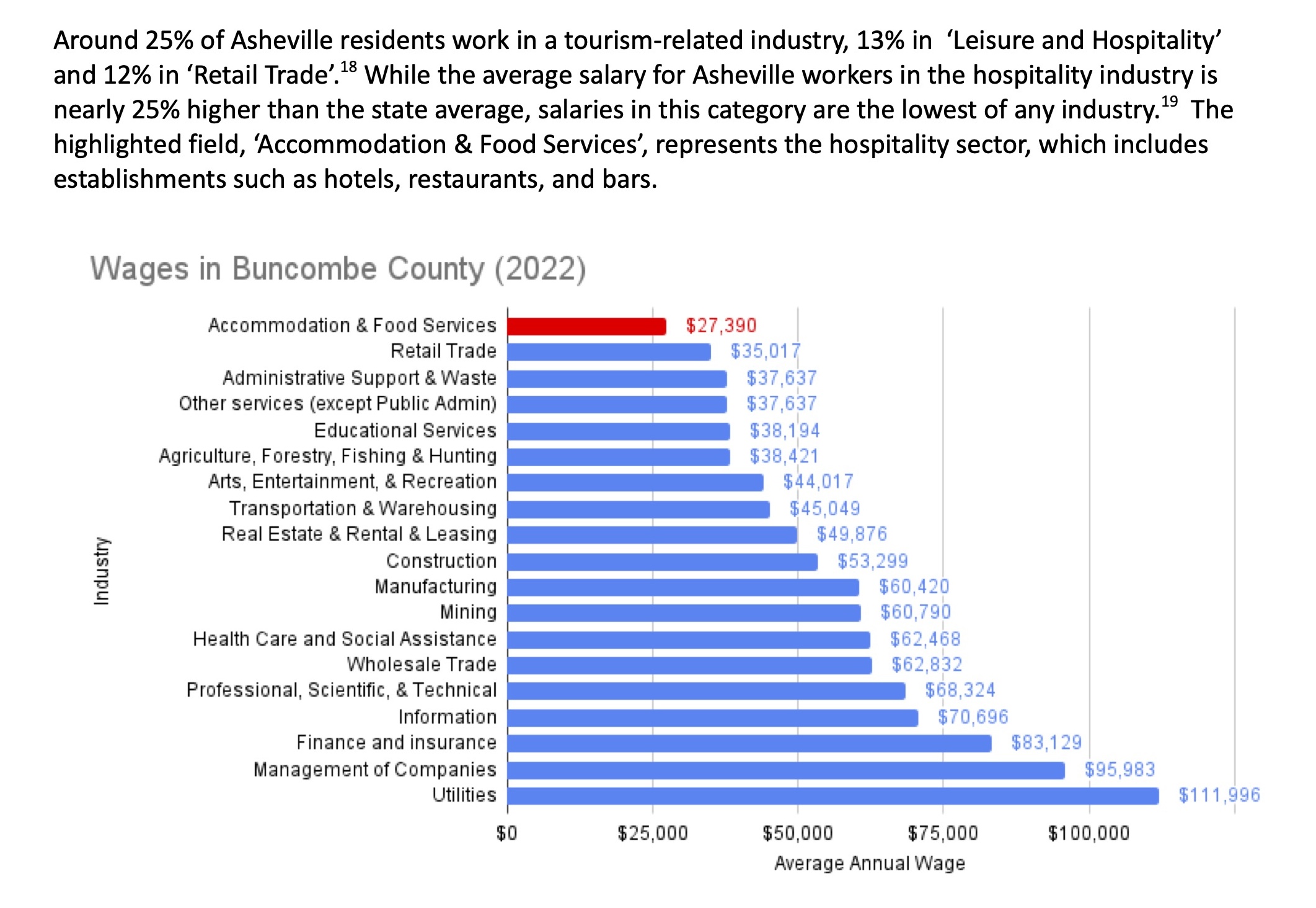
With tend-er tourism, thriving wage jobs with benefits would be an industry standard. Perhaps these benefits could be purchased through a bulk buying system.
We would invest into businesses which demonstrate care for their staff, and not in those which require underpaid labor to maintain overpaid management/ownership.
We would ensure that when the next crisis hits our community, our tourism industry workers have security to weather the predictable periodic loss of tourists.
Data-Informed
Tend-er tourism would include robust data to inform decision-making. As the Thrive Asheville report says, “To ensure an accurate understanding of the impacts of tourism now and in the future, high quality data will have to be collected.”
The GSTC recommends “Specific quantifiable socio-economic, cultural and environmental indicators and targets identified; Measurement against these indicators, with results recorded and publicised at least annually; Written evidence of monitoring and reporting of actions and outcomes; Previous reviews of monitoring system and schedule for future reviews.”
Decentralized Storytelling
The story of our home would be authentic and inclusive, reflecting the wholeness of our community.
There is nothing in the occupancy tax statue that says that advertising dollars cannot be allocated directly to local businesses and organizations and creators to promote themselves to visitors. I imagine a plethora of voices telling stories of this place through the mediums and channels they choose.
Accessible Housing
In a tend-er tourism landscape, a high percentage of STRs and hotel rooms would be converted back into/into accessible housing. Tourism would be at a reasonable level and decentralized storytelling would change the demographics of tourists, slowing gentrification and preventing the continual increase in the cost of housing.
And, when the previous goal of great jobs is manifested, we would not be in a position to need to lobby tourism industry players to invest in affordable housing for their workers, because the workers could afford housing.
Truth and Reconciliation
A common narrative I hear about tourism is something to the effect of, “tourism has been a big part of our economy for a long time, we will always be a tourist destination.”
While that may be true, what is commonly erased from this story is the very real history of the enslaved labor that was absolutely critical in building the city as a whole and the tourism industry specifically, all on land taken from Indigenous people. As if that was not enough harm/exploitation, Black people in Asheville later suffered overwhelming losses during urban renewal which was propelled in part by the tourism machine.
Today immigrant labor is key for hotels and other tourism-based businesses, and in the construction of hotels and high end housing. Many of these workers are underpaid and exploited, experiencing injustices such as wage theft and sexual harassment. The current president is a hotelier, and at one point he asked ICE not to arrest workers at hotels, farms, and restaurants, knowing those industries rely on vulnerable immigrant labor to make profits. This was eventually overridden, but very telling.
Tend-er tourism centers truth, reconciliation, and reparations. The tourists I imagine visisting in the future are comfortable with uncomfortable truths, and happy to spend their dollars in ways that help to repair past damage rather than perpetuate it.
As Movement Generation states under the tenet of “Reparations” in a Just Recovery, “Reparations must mean more than restitution for past harm. True reparations means repairing our relations. We must not only make amends for past harm, but we must reorganize the very nature of our economy so as to create new relationships going forward such that the harm can never happen again.”
Whew, that’s plenty for today, though there are many more angles to address, and actions to take. Thanks for tangling with the topic of tourism with me.


 Ami Worthen
Essential reading for anyone interested in the future of our community. Thank you, Ami.
LikeLiked by 1 person
Thank you!
LikeLike
Wonderful, many thanks Ami!
I think doing away with the TDA would be an important first step, but our political culture with its ‘public-private partnership’ mentality probably has to change first, and I’m fairly pessimistic about that. Great place to start IMHO would be to reorient away from the interests of corporate stakeholders toward smallholders. The agritourism movement in Europe does a good job of that, I think, particularly Italy, a country that derives one-seventh of its GDP from tourism, just like Asheville.
EU money, federal money, and provincial money has preserved greenspace. It works.
https://www.azulomo.com/journal/rise-of-agritourism-europe
LikeLiked by 1 person
Thanks! Great info.
LikeLike
This is a great piece, Ami. Would you be OK if I included a link to your piece in an upcoming Social Justice e-newsletter? I would offer a brief introduction that I would send to you beforehand to get your approval before including the link.
Thanks for your consideration and all you do.
LikeLiked by 1 person
Hi Ami–
Thank you so much for this thoughtful look at this complex issue. I feel quite new to all of it so it’s great gift. I’d love to be part of conversations going forward.
Kindly, Leah
LikeLiked by 1 person