Being irritated by the oversized influence of beer on our local culture and economy could be considered a waste of energy, as clearly there are more important issues to concern myself with. Which I do. At the same time, as I experience overwhelm over the cascading violence of empire, I need an outlet for my anger.
Today’s topic has been in the back of my mind for quite some time. It’s a storytelling itch I need to scratch. Another thread to pull on as we unravel the narratives that undergird ills at every level. A thread that can be rewoven in a revolutionary way.
When I published “Beer is a Bummer” in 2018, it became one of my most read and discussed pieces of writing. Many people expressed gratitude to me for voicing their shared concerns. It was telling that some told me I was “brave” for penning a critical analysis of that product and industry. I’ll reiterate that I’m critiquing systems, not the individuals who are part of them. I’m not here to judge or argue with anyone.
Since that piece came out, I’ve continued to note how beer is centered in marketing materials created for tourists that tell a story about who Asheville is and what we have to offer as a destination. Messages are always shifting in the strategies used to sell us, and the popularity of craft beer is waning, but it is still a major part of our commercialized image and economy.
There is much to be discussed around those mechanics.
Today I am focusing on history.
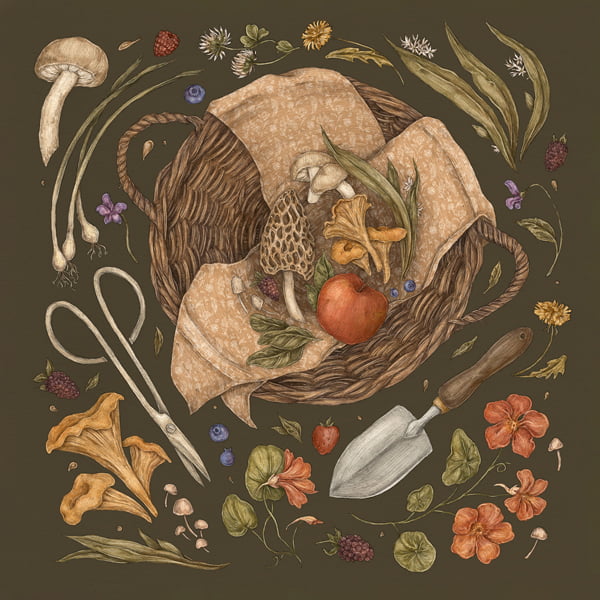
A new understanding of why I have an issue with the beer industry opened up when I read a chapter in Sarah Robinson’s book Kitchen Witch entitled, “From Beer Goddess to Alewives.” As to be expected, it includes erasure, patriarchy, and capitalism.
With all of the stories we hear about craft beer locally, most start in 1994 with the opening of Highland Brewing. Robinson’s book and other research have led me back much further back in time.
It’s a fascinating tale.
GODDESSES
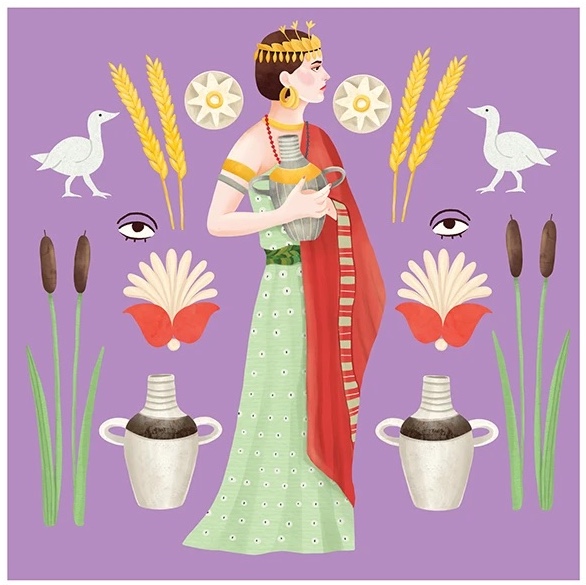
The ancient Sumarian people credited the Goddess Ninkasi with the gift of brewing beer. Sumer, as you may know, was in Mesopotamia, which was located in what is now southern Iraq. “A Hymn to Ninkasi,” which includes beer making how to’s, was etched into stone around 1800 BCE. Female priestesses were in charge of the ceremonial process of “brewing beer, a sacred, feminine, life-sustaining gift.” They created brews that were low in alcohol and nourishing.
In ancient Egypt beer making was done by priestesses of the Goddess Tjenenet, “who watched over beer brewing (and the lives of women).”
Over time, “from beer and barley wine recorded through Mesopotamia and Egypt, the brewing process, and stories of goddesses that watched over it, spread through Africa and beyond” (Robinson).
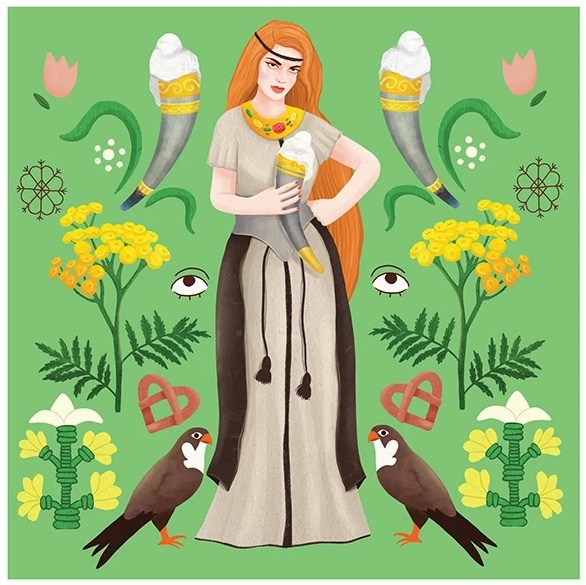
“Brewing was also a female craft among the Vikings. Only women were allowed to brew beer and all brewing equipment was their property. According to legend, beer brewing was invented to honor the Goddess Freyja” (Mason).
“All through Europe as people traveled, so did fermented drinks. Just like in Mesopotamia, Sumer and Egypt, the brewer’s craft was the provenance of women who brewed beer in the home to supplement daily meals…Women used their knowledge of herbs and plants in their brewing.”
“Across cultures, brewing was a medium for magic, guarded and blessed by both women and gods” (Robinson).
AN ABBESS AND ALEWIVES
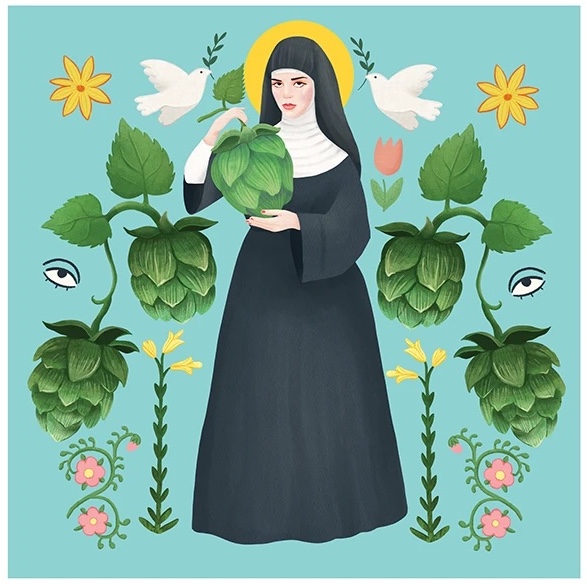
St. Hildegard von Bingen was “a German Benedictine abbess and polymath active as a writer, composer, philosopher, mystic, visionary, and as a medical writer and practitioner of the Catholic Church during the High Middle Ages” (Wikipedia). She is also credited with incorporating hops into beer, which allowed it to be stored longer. However, she was clear that hops “wouldn’t be useful to men, and that they should avoid beer altogether as it ‘makes the soul of man sad.’”
More on hops in a moment.
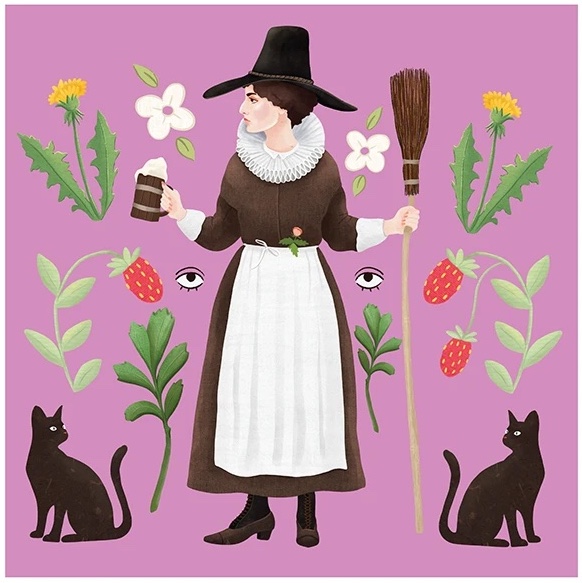
In the 1300s, the term “alewife” appeared in use in Europe for women who brewed and sold ale. During that time, widows and spinsters brewed beer for cash.
With the arrival of the plague, beer became more popular and therefore more profitable, as it was boiled and safer to drink than water. With this and other economic shifts such as the enclosure of the commons, men began to undermine the alewives.
“Although no one can prove a connection, some historians see clear similarities between brewsters [alewives] and illustrations selected for anti-witch propaganda. Images of frothing cauldrons [for brewing beer], broomsticks (to hang outside the door to indicate the availability of ale), cats (to chase away mice), and pointy hats (to be seen above the crowd in the marketplace) endure today” (Nurin).
“As brewing gradually moved from a cottage industry into a money-making one, this connection with witchcraft proved useful to men to remove women and their roles with demonization and character assasination. Europeans started seeing alewives not as legitimate business owners but as immoral women in league with the devil.”
Thus, “accusing alewives of witchcraft became a weapon, and this ancient tradition was broken” (Robinson).
On a broader scale, this is part of the story of the creation of capitalism. As Silvia Federici writes, “naming and persecuting women as ‘witches’ paved the way to the confinement of women in Europe to unpaid domestic labor” (from Witches, Witch-Hunting, and Women).
HOPS
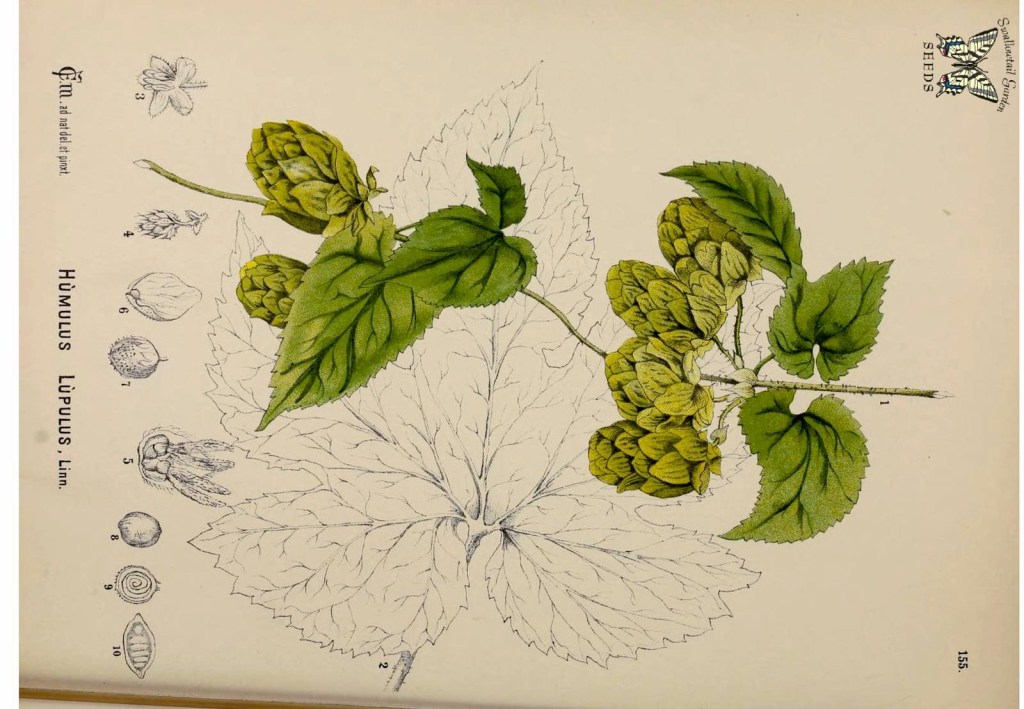
While slightly tangential, here is some related hops history (and commentary) that Chama Woydak shared in a comment on my 2018 beer essay:
“As a person who has an appreciation of beer, I agree with every single thing in this article. I think about this topic a lot and believe that no revolution ever started by a community/country consuming large amounts of hop brewed beer.
Hops are a sedative and combined with alcohol, a depressant, it brews complacency in the drinker. If there’s any town that claims enlightenment while simultaneously being complacent it’s Asheville.
Prior to the German Beer Purity Act of 1516, beer almost never contained hops. In fact, more than one hundred different plants were used in brewing beer for at least ten thousand years prior to the introduction of hops in the middle ages.
For the last thousand years of that period, the most dominant form of ‘beer’ was called gruit, which contained a mixture of yarrow, bog myrtle, and marsh rosemary. These herbs, especially in beer, are sexually and mentally stimulating. (It is rare to become sleepy when drinking un-hopped beers).
The Catholic Church had a monopoly on the production of gruit, but competing merchants and the Protestants worked together to break their monopoly and force the removal of all sexually stimulating herbs from beer. They replaced them with an herb that puts the drinker to sleep and dulls sexual drive in the male.”
*Thanks again for this interesting info, Chama.*
COLONISTS
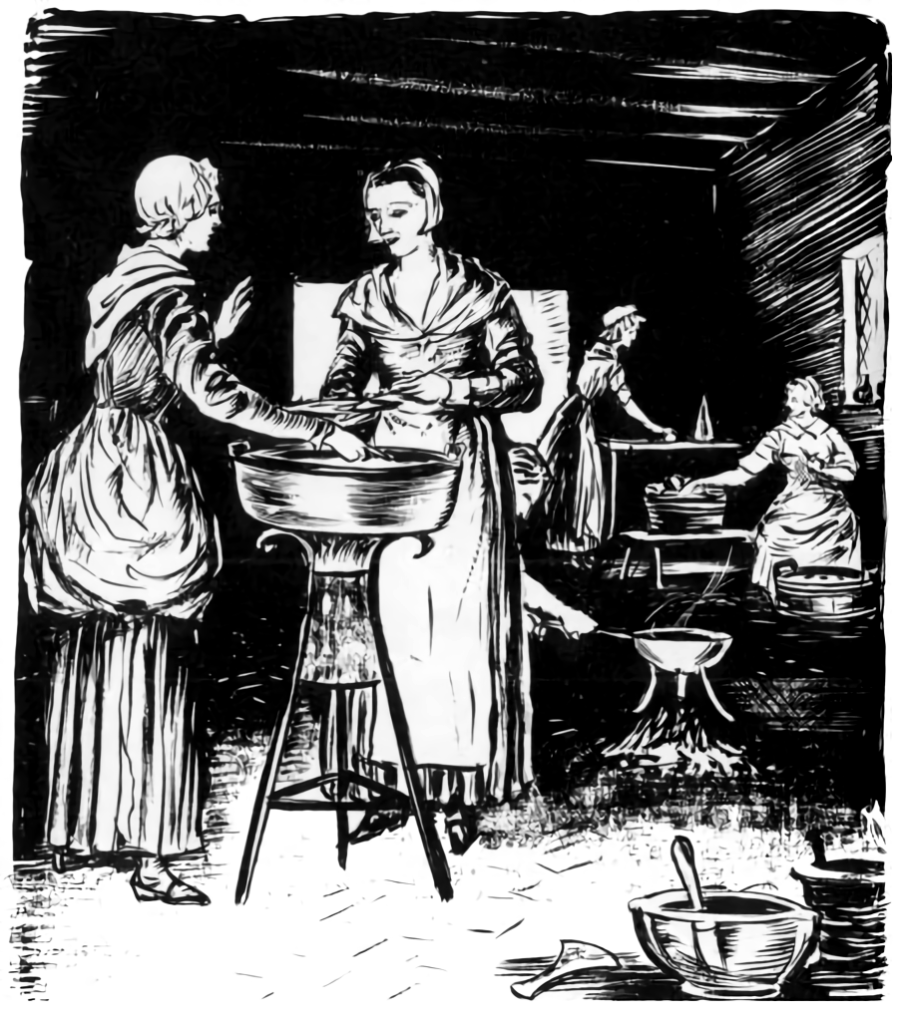
“In colonial America, as they had in Europe, married women homebrewed ‘small beer,’ which they supplemented with cider, to sustain their families. As the colonies urbanized, city men conducted their business and pleasure in taverns provisioned by regional commercial breweries.”
As in the past, “‘When money got involved, men increasingly started brewing,’ says Gregg Smith, who wrote the book, Beer in America, The Early Years: 1587–1840. ‘As the industry developed, it went that way even more’” (Nurin).
“But in rural areas, homebrewing remained the dominant source for beer for more than a century, and it wasn’t Thomas Jefferson who merited acclaim as a brewer, as folklore would have us believe. Instead, his wife, Martha, enlisted slaves at Monticello to brew her regionally famous recipes for wheat beer” (Nurin).
It’s likely that enslaved people were brewing beer in the late 16th/early 17th century taverns and stock stands along the Buncombe Turnpike, the early roots of local tourism. Which was a little earlier than 1994.
MALE DOMINATED
As it developed, the U.S. beer industry not only favored men as business owners and brewers, it centered them as consumers.
“The tightly defined gender roles of the ’50s and Mad Men-era marketers created an image of beer as a drink for men, made by commercial breweries where women were valued only as promotional vehicles” (Nurin).
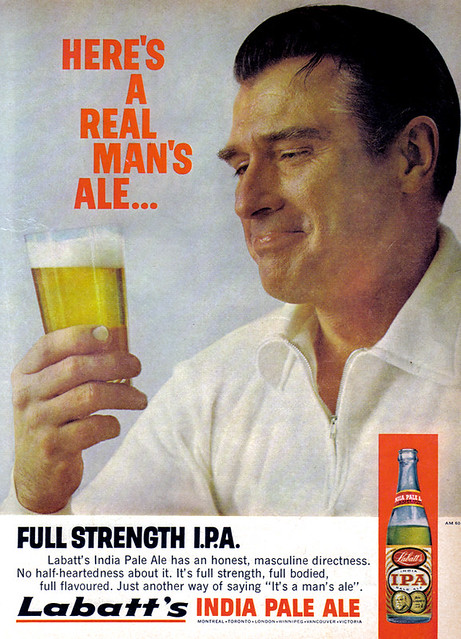
“Major beer companies have tended to portray beer as a drink for men. Some scholars have even gone as far as calling beer ads ‘manuals on masculinity’” (Brooks). It brings to mind the image of the director of the FBI in a locker room with the men’s hockey team after their Olympic win, spewing beer everywhere, proudly downing a bottle.
Again, there is a lot to unpack there. For now, let’s follow the money.
“The iconography of witches with their pointy hats and cauldrons has endured, as has men’s domination of the beer industry: The top 10 beer companies in the world are headed by male CEOs and have mostly male board members” (Brooks). At least three of those corporations have bought breweries in our area or opened their own.
A 2020 audit conducted by the Brewers Association found that 93.5 percent of U.S. brewery owners are white and 75.6 percent are male. There is only a small smattering of other races and ethnicities. More than 58 percent of breweries had no female owners, while 28.3 percent had a 50/50 split between male and female.
“A study at Stanford University found that while 17 percent of craft beer breweries have one female CEO, only 4 percent of these businesses employ a female brewmaster—the expert supervisor who oversees the brewing process” (Brooks).
Thus my coining of the word “bro-eries,” as used in the title of this piece.
The other word in the title is bombs.

BOMBS
Every thread I pull related to erasure, extraction, and exploitation has a bomb tied to the end of it. The thread could be long, but a connection exists nonetheless. The capitalist patriarchy moves in one direction – towards destruction.
On a basic level, we could look to the relationship between alcohol (including beer) and violence, particularly violence against women. The Movendi International Flagship Analysis, Alcohol and Gendered Violence, is a compelling, policy solution-oriented read on this topic.
Though maybe I was drawn into the history of beer by the fact that there is a war underway in a part of the world that was the ancient birthplace of brewing (and so much more) where goddesses were widely venerated.
Themes of disenfranchisement of women feel extra potent as this war, which we could say was started to distract us from sexual crimes against girls in this country, began with a bomb killing girls in another one.
It’s all too much, of course.
As I grieve, I’ll keep gravitating towards a more femme future that weaves in healing knowledge from the past.
CLOSING
As usual, I’m sharing research and thoughts to inspire your own inquiry and reflection.
Is beer benign, beneficial, or an elixir of inequity?
How does awareness of beer history shift our understanding of the role of this industry in our community?
What new possibilities – ancient futures – does this history offer us?
Etc.
Onward.
SOURCES
History of Women and Beer by Hanna Mason
“How Women Brewsters Saved the World” by Tara Nurin
“Why Did Women Stop Dominating the Beer Industry?” by Laken Brooks
U.S. Brewery Ownership by Ilana Davis
Women in Brewing on beerandbrewing.com
Women were the original beer brewers – what changed? Video on BBC
Kitchen Witch (book) by Sarah Robinson
Witches, Witch-Hunting, and Women (book) by Silvia Federici


 Ami Worthen
Ami, Thank you for this wonderfully researched & beautifully illustrated article. Your point of view is strong & interesting. As I thought more about the issues you raised, I remembered during my University days at Northwestern University in it’s hometown, dry Evanston, Illinois, the constant thirst & search for a beer by many students I knew. Beer runs on the bus or in a handy car, South to Howard Street, the town line with Chicago, or “Out West” to Skokie (where I drank my preference, a glass of wine or a copper cup of Moscow Mule – I was not a beer drinker). The reason Evanston was dry was mostly because it was also the home historically to the national headquarters of the Women’s Christian Temperance Union which was also very influential in the Prohibition & Women’s Suffrage movements from 1900 on.
These same issues of temperance & forbidden thirsts were prevalent in my own hometown, dry Harrodsburg, Ky., where the runs were to the nearest county lines for “last stop package good stores” or a known in-town bootlegger or home brewer.
It certainly made me ponder whether ’tis better to live in a dry town or a one ( even if makes itself widely advertised for its breweries &/or distilleries.) I know which I choose. But I do understand that in their times those ladies of the Temperance Union had powerful reasons of gendered abusive male behavior (the bad bros of back then) to deal with – so deal they did. And sometimes I’ve heard with some violence of their own against saloons & saloon keepers. And yet for the causes of abused & destitute women & children, Bully for them!
LikeLiked by 1 person
And one more comment about your astounding & astute connection between bombs and crimes against women & the hideous war this administration has started in the ancient creative lands of the Middle East, I can only grieve along with you because – It is all too much, of course.
LikeLiked by 1 person
Thank you for writing this, Ami, and the detangling of these too familiar threads.
LikeLiked by 1 person