
Black Stories in Census Tract 2
Historical Timeline ~ Compiled by Ami Worthen
1848: The oldest frame house in Asheville built by the Rankin family with a separate cookhouse that is also quarters for their enslaved cook, “Aunt Betsy.” This is the earliest documented reference to a Black resident in census tract 2.
1868: Freedwoman Tempie Avery given an acre on Pearson Drive by her former enslaver.
1880s: Stumptown, a Black community, established on 30 acres around the Avery property. It eventually grows to about 250 households.
1892: The Montford neighborhood developed for white residents. Pearson Drive becomes part of the “color line” between Montford and Stumptown.
1900s: Hill Street, a Black neighborhood, is formed. It includes significant institutions such as Hill Street School (1901), Torrence Hospital (1911), and Hill Street Baptist Church (1916).
1930: Welfare Baptist Church founded in Stumptown.
1937: Stumptown and Hill Street redlined, creating barriers to access resources.
1950s: Stumptown residents advocate for a community center and swimming pool.
White residents begin to move out of southern Montford.
1957: Crosstown Expressway built through the Hill Street neighborhood, displacing families.
1959: Hillcrest Apartments open off Hill Street as public housing for Black tenants.
1960s-70s: Urban renewal projects underway across Asheville. As Black residents lose their homes in other parts of the city, many move into census tract 2.
1967: Hillcrest rent strike begins. The strike ends successfully in 1968.
1968: Stumptown neighbors protest lack of adequate City sanitation services. The Stumptown Neighborhood Center is opened by residents in a private home.
1970: Census tract 2 is 67% Black
1977: Hillcrest Enrichment Program and High Steppin’ Majorettes & Drum Corps founded
by John R. Hayes and Sophie Dixon (who grew up in Stumptown).
1976: Shirley Hemphill, who grew up in the Hill Street neighborhood, joins the cast of nationally syndicated sitcom What’s Happening!!
1978: Aaron Mills, who grew up in Stumptown, joins the nationally touring band Cameo which goes on to have Billboard hits and gold records. He later records with OutKast.
1978: City-owned Montford Recreation Center opens. The development of the center and recreation complex takes 80 homes in Stumptown and erases the name.
1980: Census tract 2 is 74% Black
1982: First Dr. Martin Luther King, Jr. Prayer Breakfast held at Montford Community Center.
1987: Head of Montford (census tract 2) urban renewal project begins, lasts until 1993.
1990s: White investors attracted by depressed real estate prices begin to move back into the area and buy up housing stock, changing multifamily housing to inns or single family.
1997: Stumptown Reunion documented by panoramic group photo.
2000: Census tract 2 is 59% Black
2001: Stumptown Reunion dedicated to former resident Phyllis Sherrill.
2010: Census tract 2 is 36% Black
2017: Census tract 2 designated an Opportunity Zone, a federal program “to attract investment capital into low-income areas.”
2020: Census tract 2 is 28% Black
2021: STM Multimedia and Garnet Prose + Projects partner with the Historic Stumptown Neighborhood Association to document stories and produce reunion events.
2022: Stumptown is represented on the Asheville-Buncombe Reparations Commission.
2023: Stumptown Reunion documented by panoramic group photo.
2026: After years of advocacy by current and former residents, plans are underway for signage honoring the history of the Stumptown and Hill Street neighborhoods.
_____________
This timeline is, of course, incomplete. It is a starting place for discussion and discovery.
_____________
Find more information and research at montfordandstumptown.com.
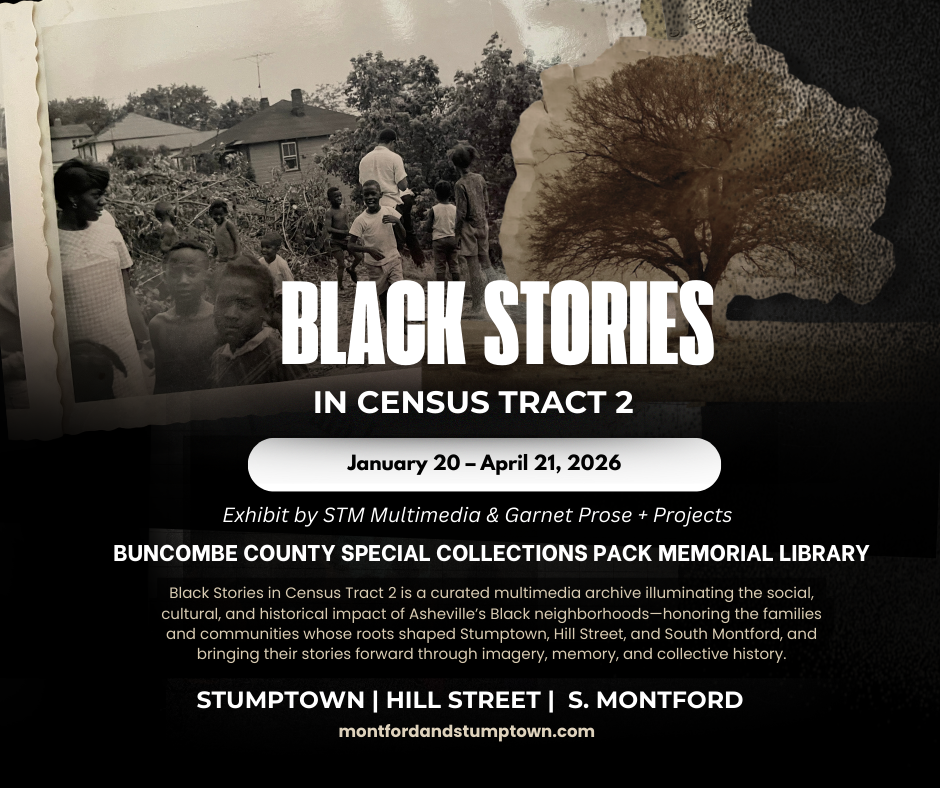
Created in January 2026 for the Black Stories in Census Tract 2 Exhibit at Buncombe County Special Collections. A collaborative project with the Historic Stumptown Neighborhood Association and STM Multimedia.

